

As climate change intensifies across the region, women-led climate solutions in Southeast Asia are becoming more critical than ever. For hundreds of millions of people, climate change is no longer an abstract concept, but a lived reality shaped by rising heat, intensifying storms, and accelerating environmental decline.
Women, particularly those in rural and agricultural communities, bear the brunt of these impacts because they form the backbone of the region’s food systems, water management, and caregiving economies.
This is why, as the world celebrates Earth Day 2026, under the theme “Our Power, Our Planet,” it is crucial to recognise that gender equality — including empowering women via science, technology, engineering, and mathematics (STEM) and climate-smart skills — can help build a more resilient Southeast Asia.
Why Climate Change Hits Southeast Asian Women Hardest
According to the UN Women’s ASEAN Gender Outlook 2024, Southeast Asian nations have reduced extreme poverty rates considerably, from an estimated 31% of the region’s population in 2000 to below 3% in 2022.
However, these gains may be lost amid climate change, with women disproportionately affected.
For instance, the report finds that women are more likely than men to live in poverty.
Additionally, because of unpaid work burdens, differences in household composition, and social norms, 17% of women in the region currently don’t consume enough nutritious food, while more women than men die from drinking unsafe water.
More worryingly, the situation could get incrementally worse if temperatures continue to rise, with 2.5 million more people, including a large majority of women and girls, at risk of falling into poverty by 2030.
In short, climate change is set to deepen existing inequalities. And without targeted action, the region stands to lose, not just economically, but also socially and developmentally.
How STEM Empowers Southeast Asian Women to Lead Climate Solutions
STEM education has long been recognised as key to sustainable development and improving gender equality.
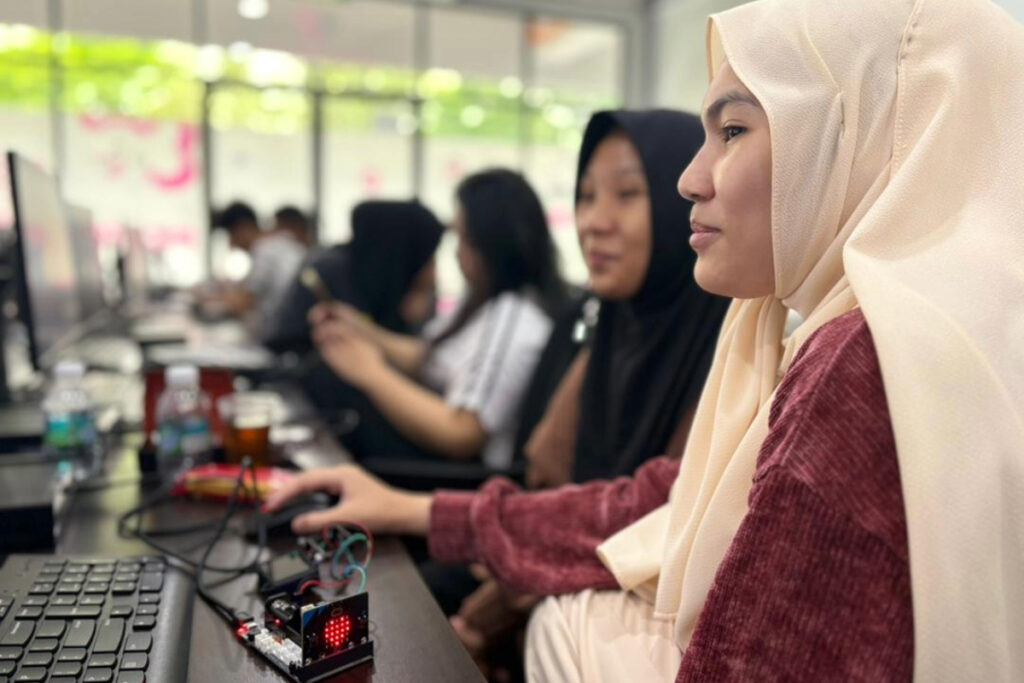
It plays an important role in dismantling stereotypes, building self-confidence in women and girls, and equipping them with skills that lead to economic empowerment. This includes building the capacity of women in the green economy through skills, resources and opportunities.
In rural and vulnerable regions, this can lead to women better understanding weather patterns, applying science‑backed farming techniques, and managing natural resources sustainably to improve their lives and livelihoods, and ultimately transform their communities.
This explains why, as Southeast Asia grapples with widening inequality and intensifying climate challenges, several organisations are turning to STEM to drive real, lasting solutions.
RYTHM Foundation’s Green Skills Project: A Proven Model
The Green Skills Project — a collaboration between RYTHM Foundation and Plan International Indonesia in Manggarai, East Nusa Tenggara — offers a strong example of how STEM-based community interventions can strengthen climate resilience in Southeast Asia.
Essentially, agriculture drives the district’s economy. However, not only have unsustainable practices and climate change exposed small farmers to climate shocks, but women have also largely been excluded from the sector.
The Green Skills Project thus introduces women to Climate-Smart Agriculture (CSA) — a modern approach to farming that protects the environment while improving harvests — and embeds gender equality and social inclusion at every step.
The result of this is:
- Some 200 youth aged 18-29, most of them women, have been trained in CSA techniques
- More than 10 youth farmer groups across six villages have been supported to create sustainable business plans
- Local governments and financial institutions have been engaged to help scale climate‑smart farming practices
Importantly, not only does this integrated approach reflect RYTHM Foundation’s broader commitment to inclusive education, community development and sustainable livelihoods, but it also addresses multiple challenges at once: environmental degradation, youth unemployment, and the gender gap in agriculture.
Women as Climate Architects: A Path Forward
Ultimately, the message is simple: our planet prospers when women are empowered.
Hence, for Southeast Asia to build true climate resilience, women must be recognised as drivers of change, not just beneficiaries.
One route to achieving that is via STEM education, which creates leadership pathways and helps communities move forward together in the face of climate challenges.
Earth Day reminds us that environmental progress is built through everyday action. Yet for real change in Southeast Asia, it is not enough to recognise the problem. Rather, it is crucial to equip people, especially women, with the tools and know-how to strengthen communities and secure a more sustainable future for the region.